
How to Do SOAR Analysis (with Free Template)
Updated by Xtensio
Take a future-focused approach to strategy with the SOAR framework—Strengths, Opportunities, Aspirations, Results. Follow our step-by-step guide and edit the free template live to explore each section. Ready to build your roadmap?
Xtensio is your team space for beautiful living documents.
Create, manage and share business collateral, easily.
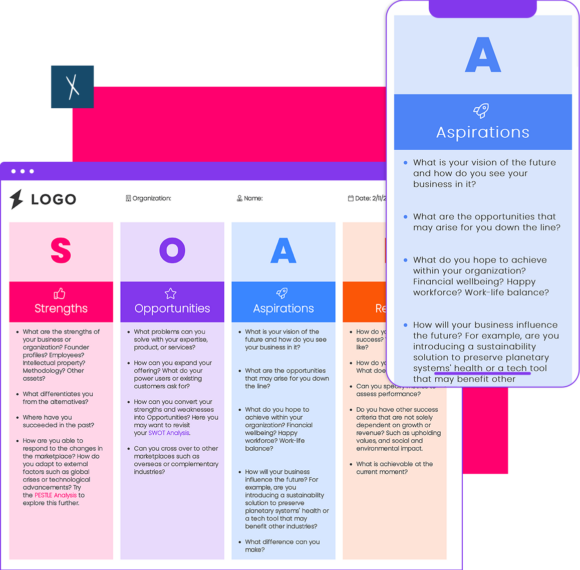
Table of Contents
Introduction
What is SOAR Analysis?
SOAR Analysis stands for Strengths, Opportunities, Aspirations, and Results. It’s a strategic planning tool that helps businesses focus on their current strengths and future vision rather than weaknesses and obstacles.
Who Needs to Perform SOAR Analysis?
This tool is handy for business leaders, managers, and entrepreneurs who aim to comprehensively understand their organization’s potential and lay down an actionable roadmap for the future.
Importance of SOAR Analysis
By focusing on the positive aspects of your business, SOAR allows you to create a shared vision of the future and generate actionable strategies that drive results.

The SOAR Framework: Breaking It Down
Strengths
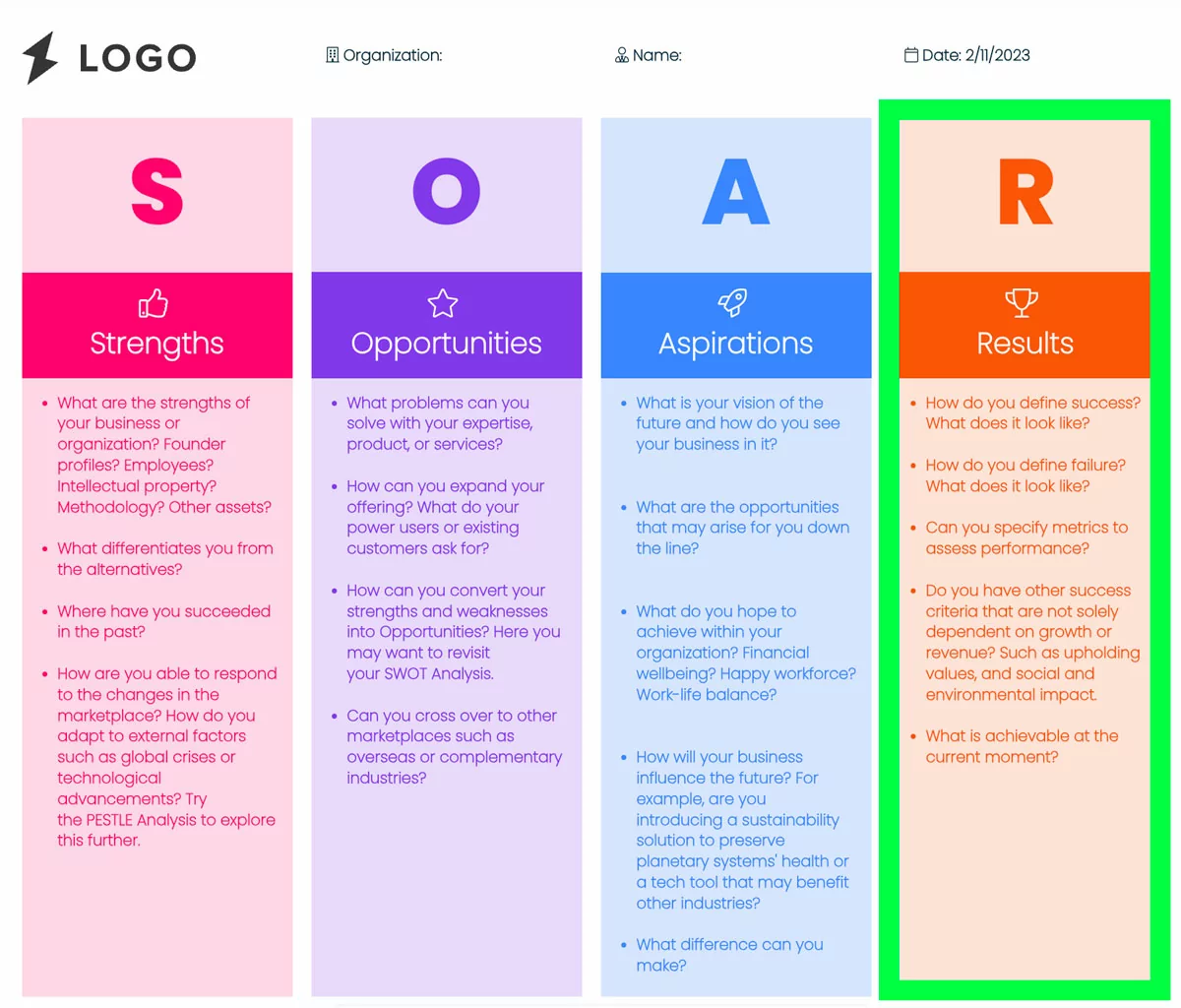
In SOAR Analysis, strengths refer to your existing assets and what sets you apart from competitors. The goal here is to identify these elements and consider how you can leverage them to achieve your aspirations and produce tangible results.
Opportunities
Opportunities are external factors or trends that you can capitalize on to achieve your aspirations. This could be anything from emerging markets, technological advances, or even new legislation benefiting your industry.
Aspirations
These are your desired future states, the dreams, and ambitions you want your business to realize. Aspirations should align closely with your organization’s mission and vision statements to keep your team motivated and working cohesively.
Results
Here, you identify the tangible outcomes you aim to achieve. Results are measurable and aligned with your aspirations, serving as key performance indicators (KPIs).
Differences Between SOAR and SWOT
Conceptual Differences
While SWOT focuses on both strengths and weaknesses, opportunities and threats, SOAR concentrates solely on the positive—strengths and opportunities—while also incorporating aspirational goals and expected results.
Application Differences
SWOT is generally used for situational analysis, whereas SOAR is designed for strategic planning, making it more actionable.
Benefits and Limitations
SOAR offers an optimistic approach that’s well-suited for team motivation and aligning different departments towards a shared vision. However, it might overlook potential threats or weaknesses that a SWOT analysis could uncover.
Why Choose SOAR Over Other Frameworks?
See SWOT and SOAR Analysis alternatives here
Focused on the Future
SOAR emphasizes long-term planning and helps you build a roadmap to achieve your aspirations.
Encourages Positive Thinking
This tool shifts the focus from problem-solving to appreciating your current assets and figuring out how to maximize them for future growth.
Easily Adaptable
SOAR can be adapted to fit various business types and sizes, making it a versatile option for strategic planning.
When to Use SOAR Analysis
Business Expansion
Use SOAR when contemplating entering a new market, launching a product, or otherwise scaling your operations.
Product Development
SOAR is invaluable when you’re planning to launch a new product or refine an existing one, as it helps you align the product with your company’s strengths and the market’s opportunities.
Team Building
If you’re restructuring or expanding your team, a SOAR analysis can provide insights into the strengths of your existing team and the opportunities for future hires.
Setting Up for SOAR: Preparation Steps
Stakeholder Identification
Recognize who should be involved in the SOAR process, from C-level executives to department heads, and even external stakeholders like customers or suppliers.
Data Collection
Compile existing reports, customer feedback, and financial statements that will give you a clear view of your current strengths and opportunities.
Meeting Schedules
Decide how often SOAR meetings will take place and who will be in attendance, ensuring regular updates and accountability.
How to Do SOAR Analysis: Conducting The Analysis

Ready to roll up your sleeves and dig into the SOAR Analysis? We’ll walk you through each crucial component—Strengths, Opportunities, Aspirations, and Results. We’ve laid out easy-to-follow steps, sprinkled in some handy tips, and even thrown in real-world examples to make things crystal clear. Use Xtensio’s FREE online template and follow along.
Total Time: 1 hour
-
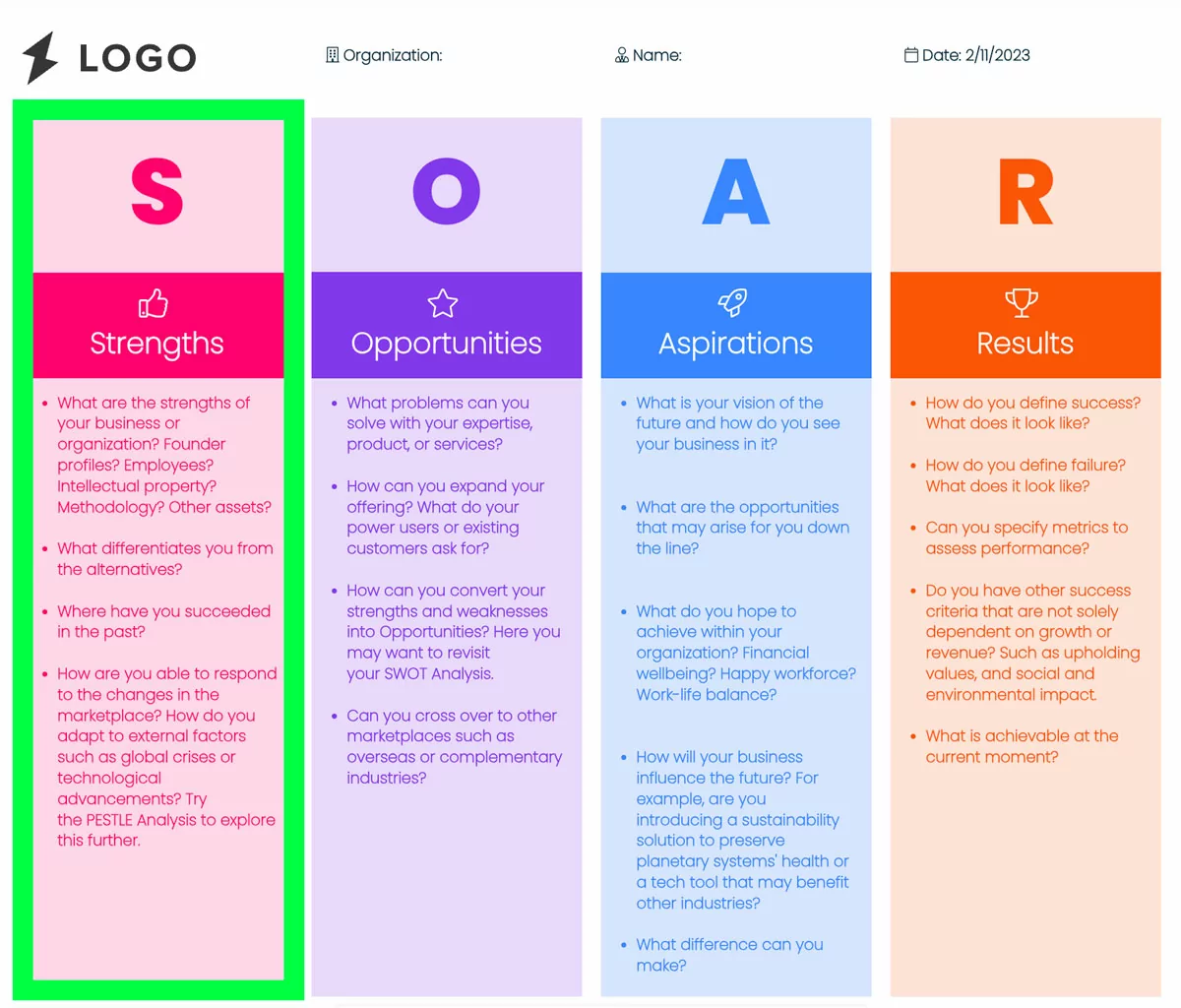
Define Strengths

Start by identifying what your organization excels at. This can range from a dedicated team to a unique selling proposition (USP) that sets you apart from the competition.
Tips:
Involve a diverse set of stakeholders, as different perspectives can bring new insights.
Use data, like customer reviews and performance metrics, to quantify strengths.
Best Practices:
Document all identified strengths in a centralized location, making it easier to reference them later.
Always tie strengths back to real business outcomes.
Example:
If your customer support team is highly rated, that’s a strength that can directly impact customer retention. -
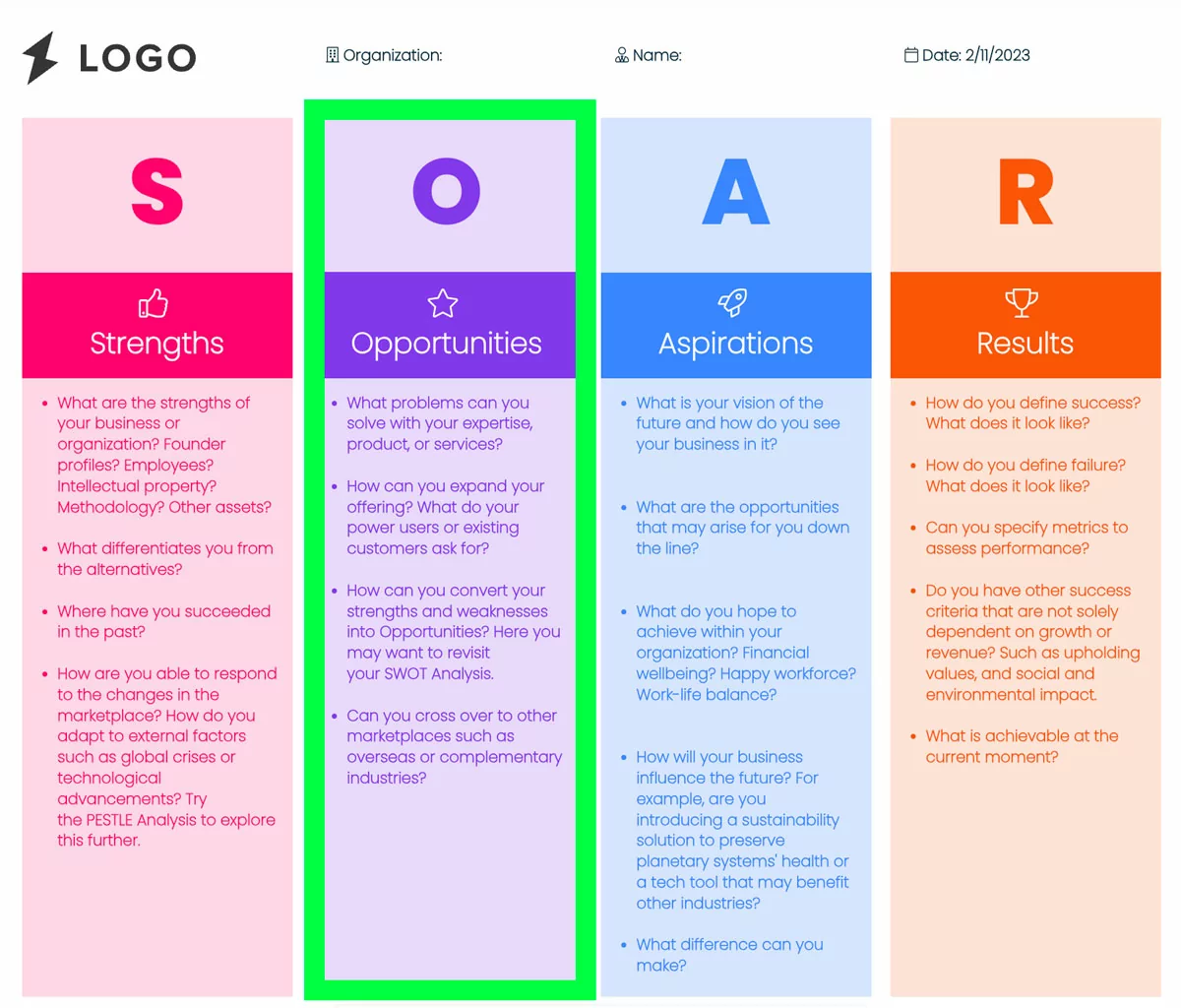
Pinpoint Opportunities
Look at the external factors that could favor your organization. These could be market trends, consumer behavior, or even legislative changes.
Tips:
Conduct market research to identify these opportunities.
Be as specific as possible, so you can tailor your strategies accordingly.
Best Practices:
Prioritize opportunities based on potential impact and feasibility.
Review these regularly, as opportunities can change over time.
Example:
If you’re in the renewable energy sector, growing environmental concerns could be a massive opportunity for your business. -
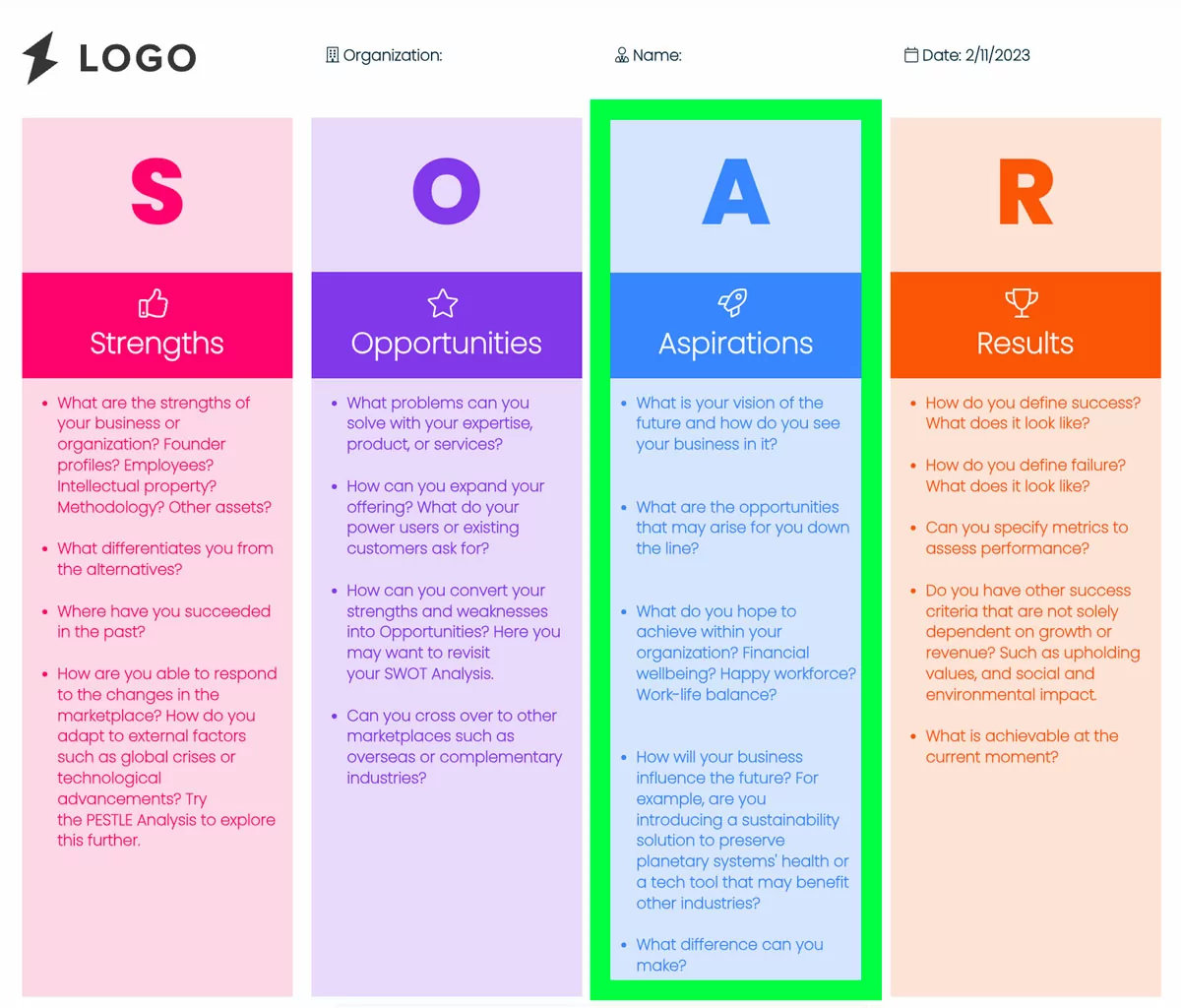
Set Aspirations
Aspirations are the long-term goals you wish to achieve. They should align with your organization’s mission and vision.
Tips:
Engage in brainstorming sessions with key team members.
Make sure these aspirations are attainable but challenging.
Best Practices:
Use SMART criteria (Specific, Measurable, Achievable, Relevant, Time-bound) to define your aspirations.
Make sure they align with your strengths and opportunities.
Example:
If you’re a tech company with strengths in innovation, an aspiration could be to become the industry leader in artificial intelligence solutions within five years. -
Realize Results
Here, you’ll define the tangible outcomes—often KPIs—that will measure the success of reaching your aspirations.
Tips:
Make sure your results are quantifiable and time-sensitive.
They should be realistic given your identified strengths and opportunities.
Best Practices:
Involve team members who will be responsible for these outcomes in the setting process.
Use a variety of KPIs that capture different aspects of your goals, like revenue targets and customer engagement metrics.
Example:
If one of your aspirations is to expand globally, a measurable result could be to enter three new international markets within the next two years.
Supply:
- Internet connection
Tools:
- Xtensio.com
Materials: None
Understanding the Role of Teamwork
Cross-Departmental Collaboration
To get the most out of your SOAR analysis, involve different departments like marketing, sales, and R&D to gather diverse insights.
Leadership Involvement
Senior leadership should be heavily involved to ensure the strategic alignment and resource allocation needed for successful implementation.
External Facilitators
Sometimes bringing in an external facilitator can provide a fresh perspective and help avoid internal biases.
How to Collect Data for SOAR Analysis
Surveys and Questionnaires
These can be circulated among employees, customers, and other stakeholders to gather qualitative data.
Interviews
One-on-one interviews with team members and external stakeholders can offer deeper insights into your organization’s strengths and opportunities.
Focus Groups
These are helpful for brainstorming and can reveal shared aspirations among different stakeholders.
Analyzing Your SOAR Data
Qualitative Analysis
For textual or non-numerical data, methods like thematic analysis or sentiment analysis can be applied.
Quantitative Analysis
Use statistical methods to analyze numerical data, comparing trends over time or between different departments.
Gap Analysis
Identify the differences between your current state and your aspirations, and plan how to bridge these gaps.
Creating a SOAR Action Plan
Task Allocation
Break down the strategies into tasks and assign them to relevant team members.
Setting Milestones
Create a timeline with significant milestones for each strategic initiative.
Monitoring and Control
Regularly track progress using the predefined KPIs and adjust the plan as necessary.
Implementing the SOAR Action Plan
Roles and Responsibilities
Ensure everyone is aware of their roles and responsibilities in implementing the action plan.
Risk Management
Identify potential risks and prepare contingency plans.
Flexibility in Execution
The plan should be flexible enough to accommodate changes, as no strategy can accurately predict all future events.
Measuring Success: Key Performance Indicators
Financial Metrics
These could include ROI, profit margins, or revenue growth as indicators of success.
Customer Feedback
Customer satisfaction surveys or Net Promoter Scores can provide valuable insights into how your strategies are affecting your user base.
Employee Engagement
A motivated team is often a sign of a successful strategy. Track employee engagement levels before and after the implementation of your SOAR plan.
Fine-Tuning Your Strategy Post-SOAR
Regular Updates
Update your SOAR analysis regularly to adapt to any changes in the internal or external environment.
Stakeholder Feedback
Regularly collect and analyze feedback from all stakeholders to continuously refine your strategy.
Market Analysis
Keep an eye on market trends and adjust your strategies accordingly to maintain or gain a competitive edge.
Common Pitfalls and How to Avoid Them
Unrealistic Aspirations
Ensure that your aspirations are achievable by setting SMART goals—Specific, Measurable, Achievable, Relevant, and Time-bound.
Data Overload
Don’t get bogged down with too much data. Focus on what’s most relevant to your strategic goals.
Poor Communication
A lack of communication can derail your SOAR analysis. Ensure all stakeholders are on the same page by maintaining open lines of communication.
Ignoring Results
Ignoring or not accurately measuring results can be detrimental. Always have mechanisms in place for tracking KPIs and adjusting your strategy accordingly.
Conclusion
SOAR analysis is an invaluable tool for any organization looking to identify its strengths, capitalize on opportunities, align with aspirational goals, and produce tangible results. It shifts the focus from problem-solving to strategic planning based on what your organization does well. Unlike traditional SWOT analysis, it’s a positive, future-focused approach that can energize your team and get everyone moving toward a shared vision of success.
By following this comprehensive guide, you’ll be well on your way to mastering the art of SOAR analysis, setting your organization on a path to sustained growth and success.
Written by

Templates related to the SOAR Analysis


Teamspace for smart, beautiful deliverables.








375,214 users and counting…
