
How to Develop a Content Strategy
Updated by Xtensio
A strong content strategy boils down to creating the right type of content for your target audience. This comprehensive planner gives you a clear overview of your content strategy, walking you through the major elements to plan, execute, publish, and optimize your content. Follow along with this template.
Xtensio is your team space for beautiful living documents.
Create, manage and share business collateral, easily.
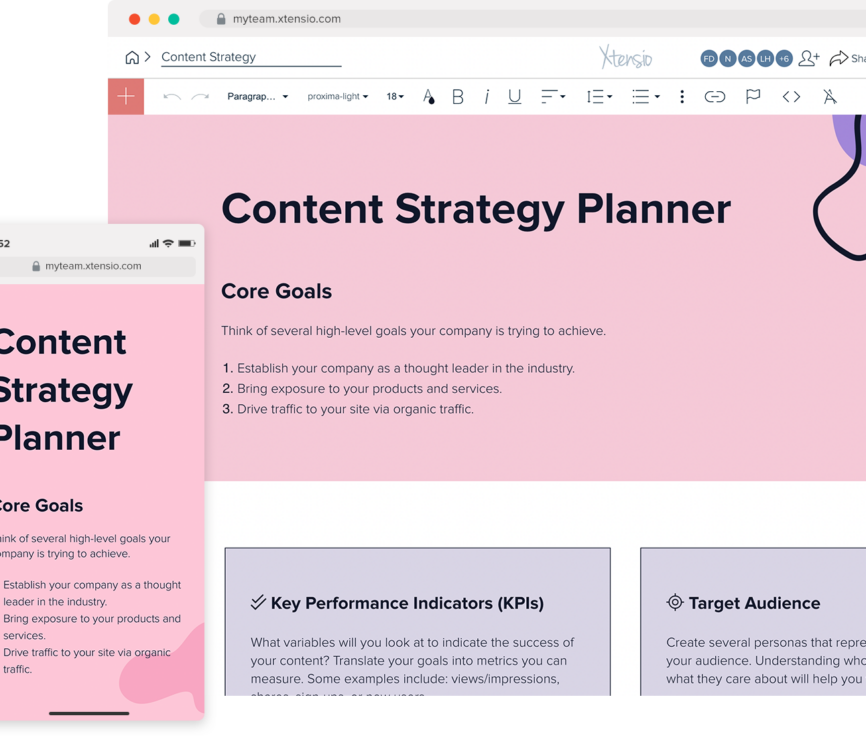
Table of Contents
What is a Content Strategy?
When it comes to content marketing, there may be a number of people who work on your content: copywriters, designers, producers, analysts, SEO experts, and more. One way to eliminate any confusion and streamline content creation across the marketing team is to have a content strategy plan that can be seen by all the key members, aligning everyone’s objectives.
Simply put, having a strategy can help your company create better content. However much social media and blogging have become such an important part of a company, it is also important that your content isn’t just fluff. You want people to leave your content feeling as if they have found an answer to a lingering question or have learned something that they had not known before. If your content is not helping in some way, It’s better to not contribute to the noise of useless online content.
Identify Core Goals
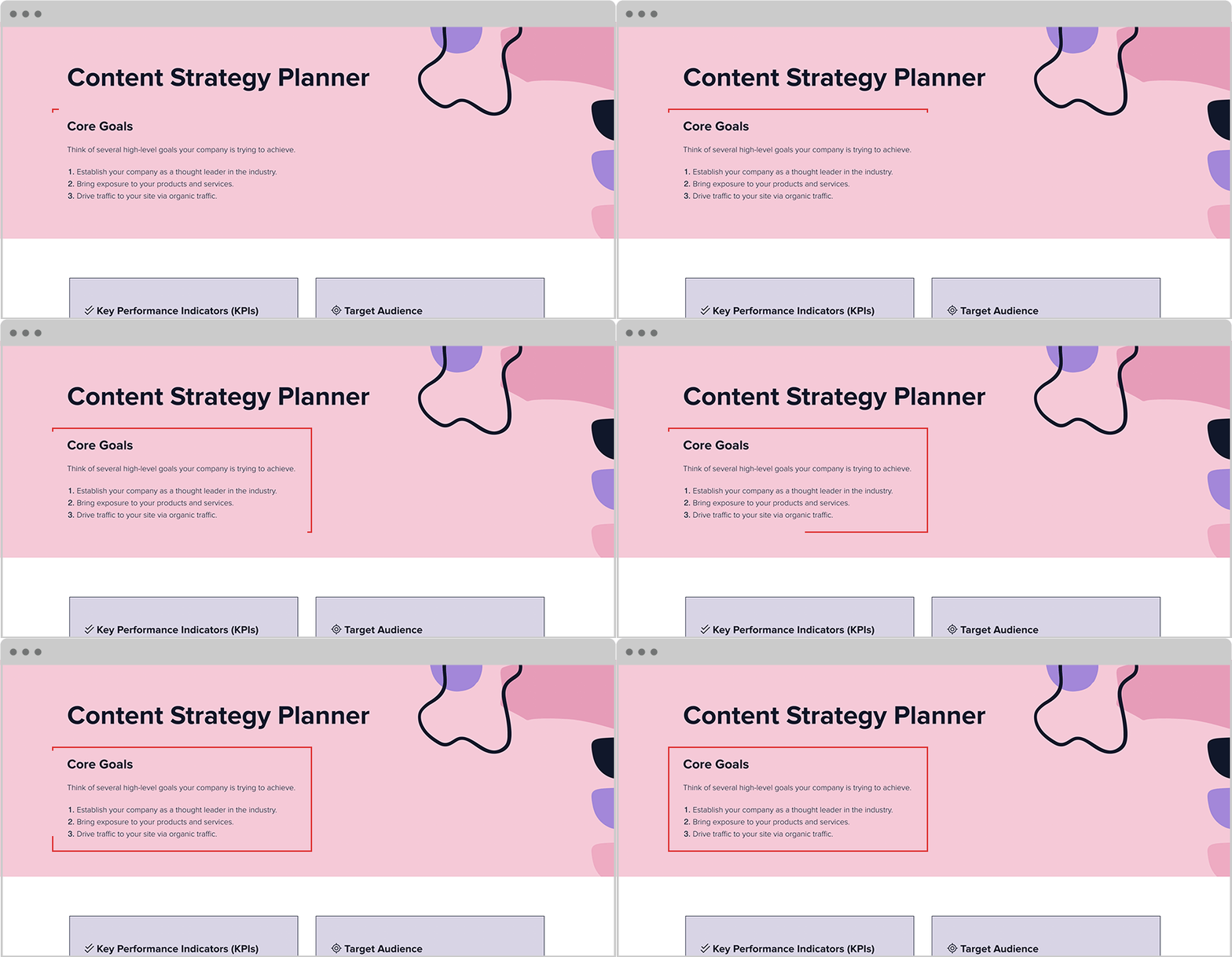
The first step of developing your content strategy is to identify the goals you’re trying to reach through your content or inbound marketing efforts. These goals should be high-level, meaning they should be broad statements or generalities rather than focusing on the fine details. Establish a few SMART goals and build your content around them. Here are some examples:
- Drive traffic to your site via organic traffic. This means you want your content to be optimized for search engine results so that when users search for your company’s products, services, or keywords, they will find you.
- Bring exposure to your products and services. When users come to your content to find solutions to their questions, your product or service will be forefronted to meet their needs. This exposure can potentially convert visitors into paying customers.
- Become thought leaders in the industry. Your brand goes beyond its mere product or service; the content you produce is a huge reflection of your brand image. If you produce quality content that embodies your company’s mindset and brings value to your audience, you’ll be able to establish your company as thought leaders in the industry.
To offer a unique perspective with your content make sure to establish your Brand Guidelines. Sustain a creative vision that reflects your brand’s personality, voice, and tone.
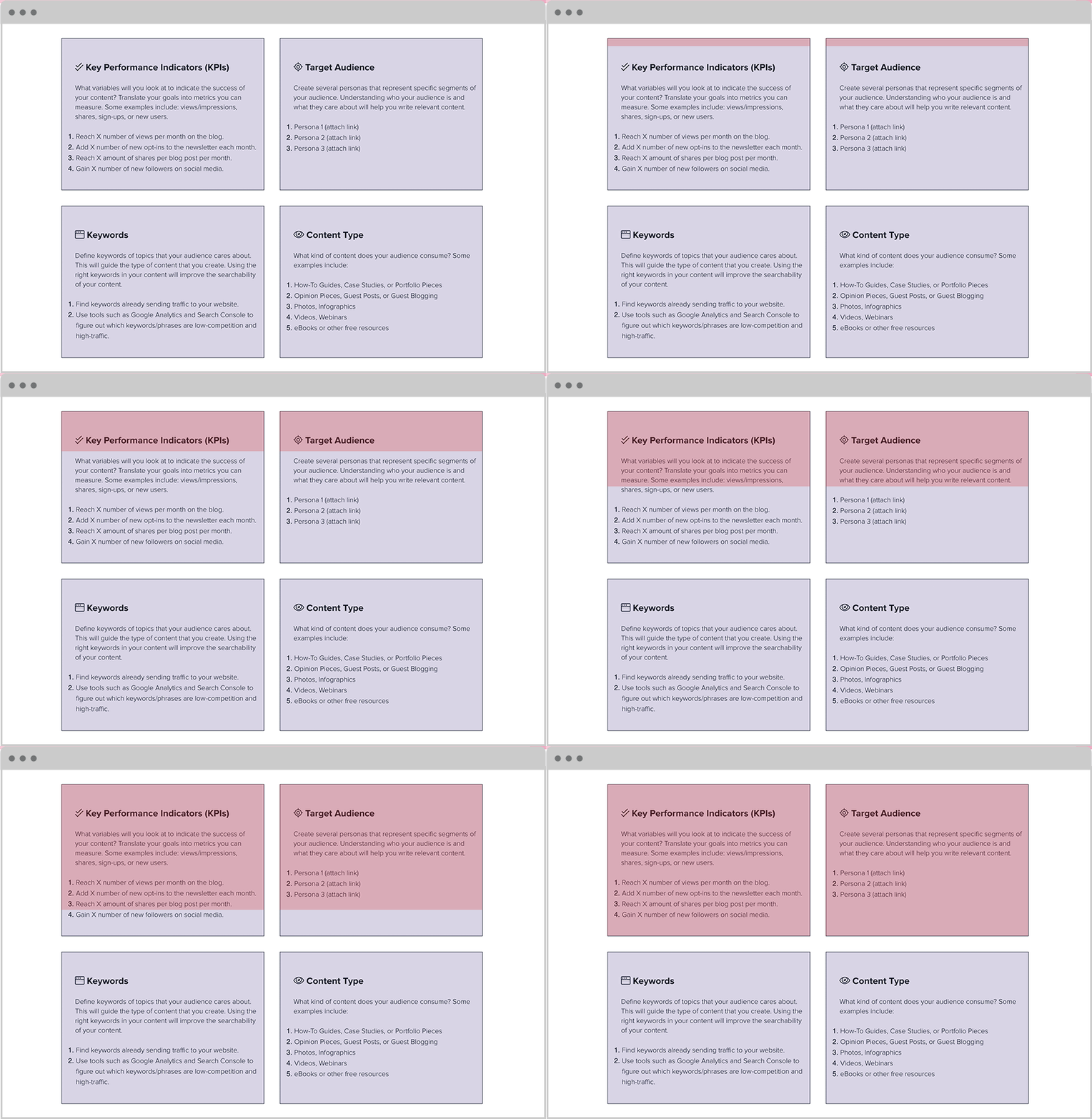
Pro Tip: Define your KPIs to align with your core business goals. Filling out the brand positioning canvas or the lean canvas can help pinpoint what your unique value is and define what goals you need to reach.
- Unique or total views/impressions
- Number of new users or customers
- Total revenue
- Number of newsletter sign-ups
- Number of times your content is shared
- Reach X number of views per month on the blog.
- Gain X number of new followers on social media.
- Generate $X in revenue
- Add X number of new opt-ins to the newsletter each month.
- Reach X amount of shares per blog post per month.
- Include a keyword cloud or change the trait labels into topics
- Change Motivations to various content types such as Blogs, Podcasts
- Change Preferred Channels to Acquisition Channels such as Search, Social, Referral, Direct, etc.
- Xtensio’s User Persona Creator helps you humanize your target audience and boil down the most important elements of their personality onto one page.
- A step-by-step guide on how to fill out your persona. It’s by no means a strict guide to create your persona. Re-label sections, move sections around, adjust it however you think it will help your content creation.
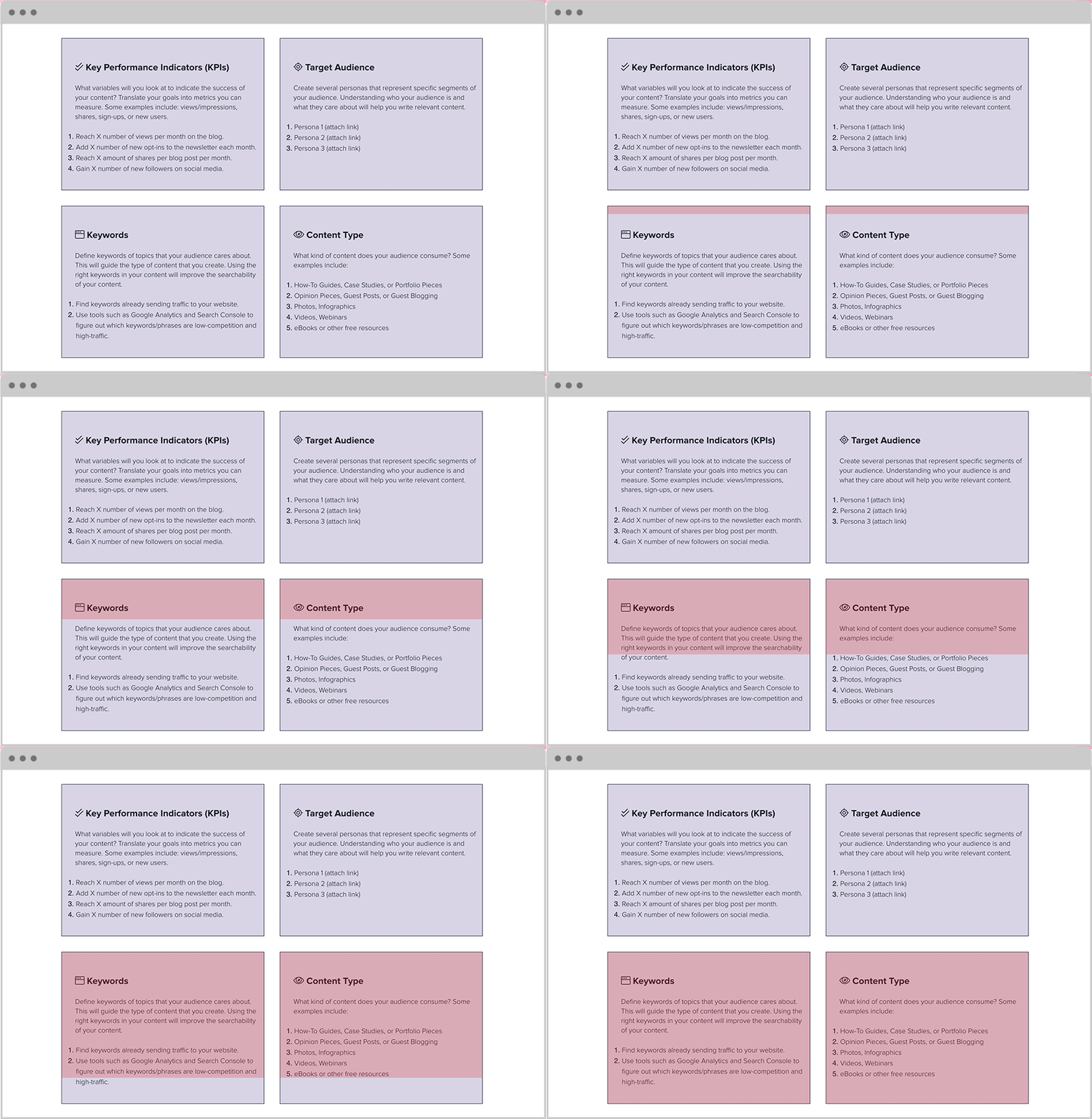
Quick Tip: Conduct essential strategy exercises before deciding on your content type. Use the competitive analysis template or the ecosystem mapping template to analyze what your competitors are doing, what’s working and what’s not.
- Google Search Console – find the keywords already sending traffic to your website.
- Google Keyword Planner – determine which keywords or phrases are low-competition and high-traffic.
- Google Trends – see how search queries compare and how they’ve changed over time.
- How-To Guides, Case Studies, or Portfolio Pieces
- Opinion Pieces, Guest Posts, or Guest Blogging
- Photos, Infographics
- Videos, Webinars
- eBooks or other free resources
- Newsletters
- Landing pages and Link in Bio pages
- 191 Different Types of Content by PR Daily
- 17 Types of Content That Will Drive You More Traffic by Neil Patel
Frequency Calendar
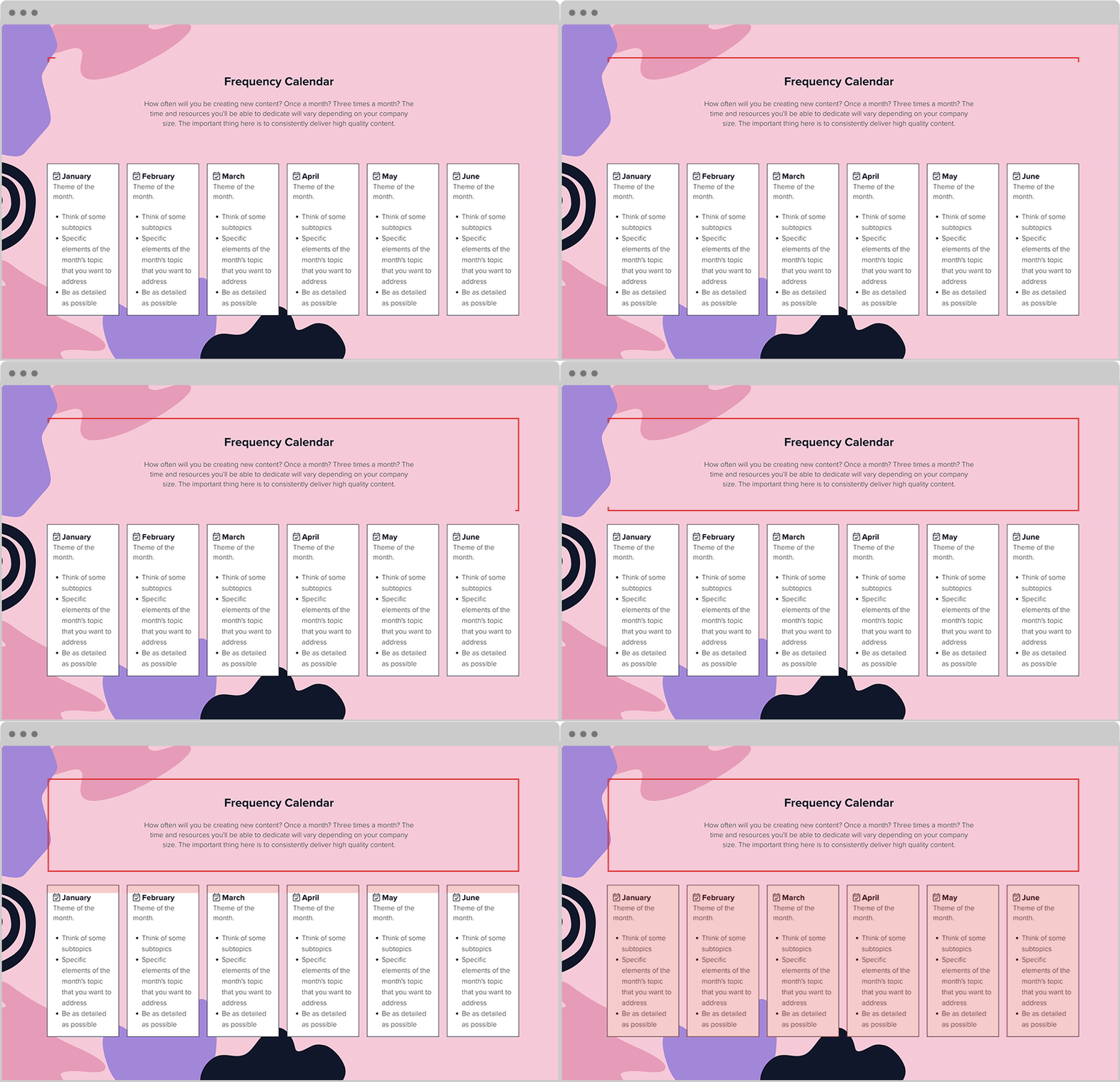
How often will you be creating new content? Once a month? Three times a month? Think of your calendar broadly and then go into the finer details afterward. The template is naturally organized for you to think six months into the future. Here’s an example use case for these six months:
6 Month Theme: How Personas Can Help You Make Smarter Business Decisions
- January Topic: Personas for Content Marketing
- Week 1: If Your Target Audience is Everyone, You’re Marketing Wrong (Blog)
- Week 2: How to Design a Persona Tailored for Content Marketing (Blog)
- Week 3: The Right Content Type By Demographic (Infographic)
- Week 4: Why Defining Your Brand Tone is Trial and Error (Blog)
- February Topic: Personas for Startups
- March Topic: Personas for Enterprise
- April Topic: Personas for SEO
- May Topic: Personas for UX Design
- June Topic: Personas for Media Buying
For this 6-month time frame, define one overarching theme. Define a topic for each month, and create subtopics that can guide your content creation. By creating a content calendar early, you’ll always have content ideas ready that follow a natural progression. Even more importantly, publishing content consistently will encourage return visits. Once your audience has come to expect content from you at a certain time, it’s best to make sure the flow stays regular.
Resources:
- Contentacle – Simple Content Marketing for Teams
- MindMeister – Collaborative mind mapping tool
- Trello – Card-based project management
- Hootsuite or Sprout Social – Social Media Management
Publishing Procedures & Distribution Channels
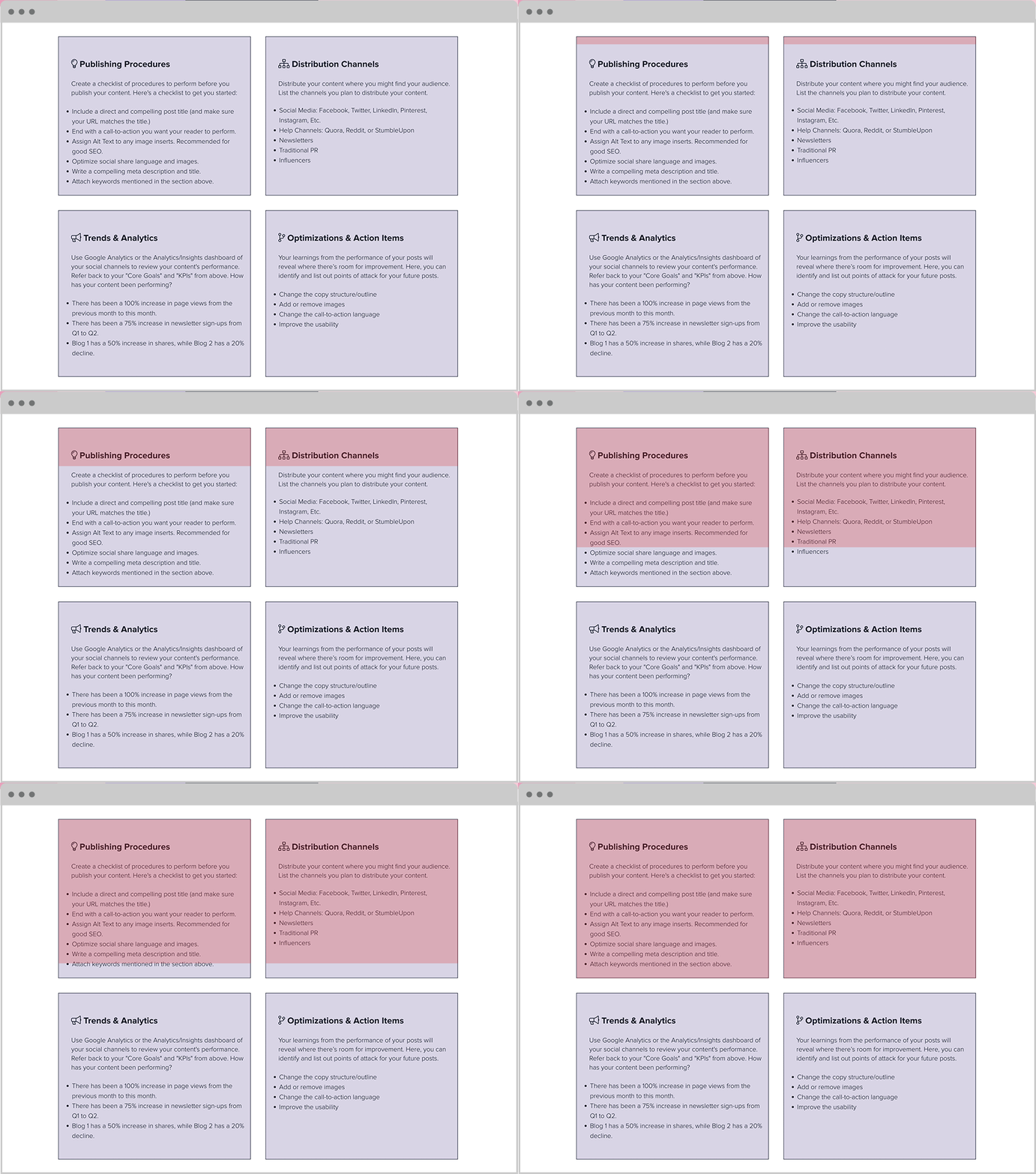
Publishing your material might be intimidating at times, especially when you’re sending an email newsletter to 50,000 people or posting on your Facebook page, which has 200,000 likes. Make sure you cover all of your bases and triple-check for spelling typos or broken connections. Create a checklist of processes to follow before publishing your material.
Here’s a checklist to get you started:
- Proofread for spelling and broken links (obviously)
- Include a direct and compelling post title and make sure your URL matches
- End with a call to action you want your reader to perform
- Assign Alt Text to any image inserts (recommended for SEO)
- Optimize social share language and images
- Write a compelling meta description and title
- Saturate your content with the keywords mentioned in the section above
Distribution Channels
Where might you find your target audience? Every medium is different, what goes onto Instagram can’t possibly be the same as what goes on LinkedIn. Every platform has a finesse that will yield the most results for your company. Using the same example from earlier, will you find an audience of girls aged 14-21 on LinkedIn? Maybe a few. But if you’re trying to market your beauty products to this demographic, they won’t be looking for it on LinkedIn.
Lastly, do some research as to what tone and style fits each channel, then mold that into the tone and style of your company. Be prepared for trial and error.
Here are possible channels to distribute your content:
- Social Media: Facebook, Twitter, LinkedIn, Pinterest, Instagram, Etc.
- Help Channels: Quora, Reddit, or StumbleUpon
- Newsletters
- Traditional PR
- Influencers
To determine the ideal channels and times to reach your customers, analyze a Day in the Life of your audience. This is a type of customer journey mapping exercise, which can improve the efficiency of your content game by finding your audience where they’re at and when they might tune into your posts.
Trends, Analytics, Optimizations and Action Items
Trends & Analytics
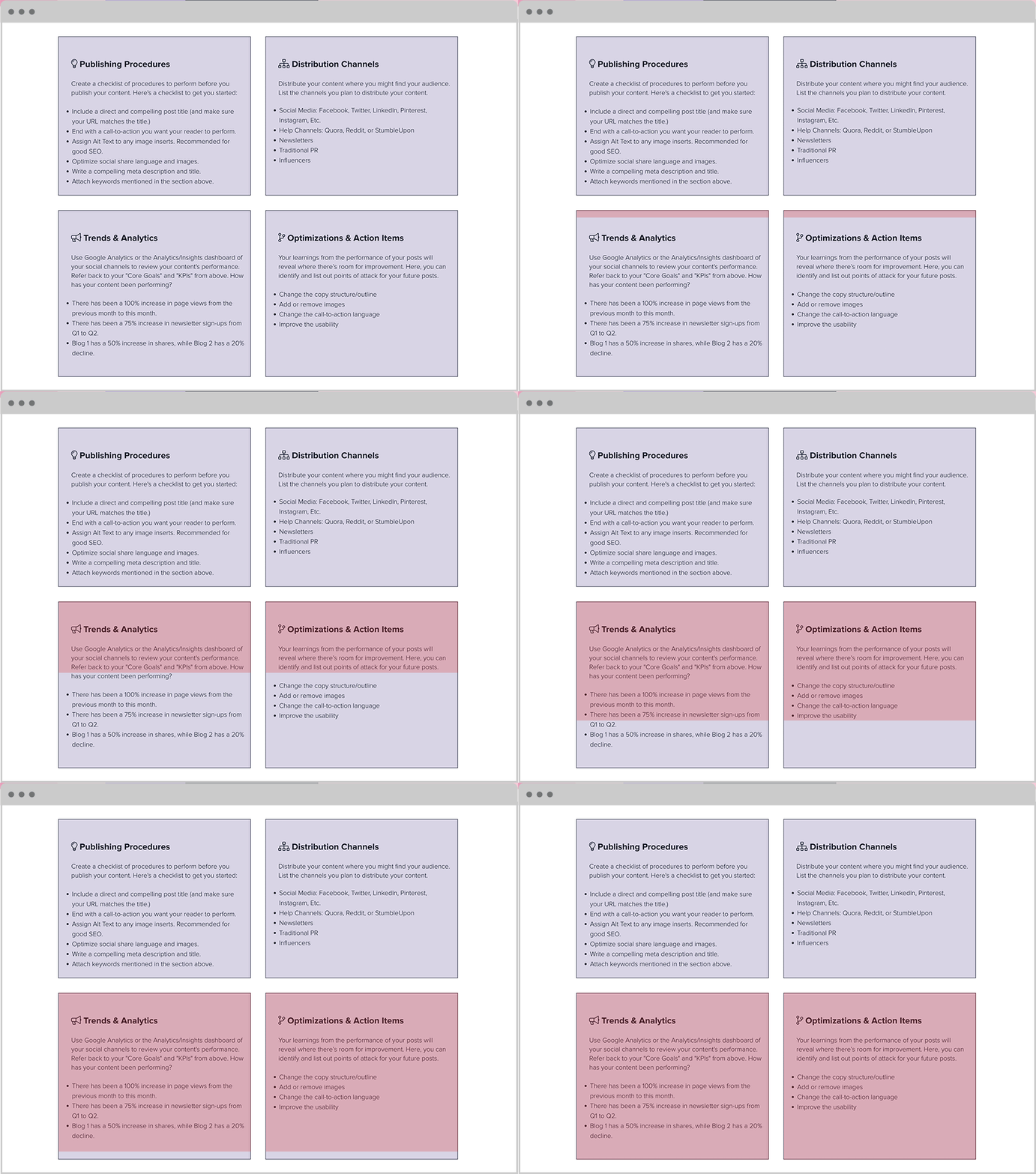
How has your content been performing? Keep a close eye on the performance of each post and keep track of any trends. Use Google Analytics or the Analytics/Insights dashboard of your social channels to review your content’s performance. Refer back to your “Core Goals” and “KPIs” from above. Deciphering your analytics data allows you to further optimize your content and perfect your strategy.
To see these trends, you’ll want to record and review changes month-to-month (or year-to-year). This way you can see if there is an explicit positive to negative trend over time. You will likely want to monitor unique vs total page views, bounce rate, and conversion rate (whether that’s purchases, sign-ups, or whatever you define as a conversion). This is by no means an exhaustive guide to uncovering key insights from your analytics — It’s on you to dig through the data and pull out useful information.
Here are some example insights you might find:
- There has been a 100% increase in page views from the previous month to this month.
- There has been a 75% increase in newsletter sign-ups from Q1 to Q2.
- Blog 1 has a 50% increase in shares, while Blog 2 has a 20% decline.
Your learnings from the performance of your posts will reveal where there’s room for improvement. Based on your findings, what are some actionable items for improvement? Let’s say you notice that one blog is significantly outperforming your other blogs at converting visitors. Review what’s different. Maybe it’s the language, or the placement of your sign-up form, or maybe it’s simply a strong topic choice. Take these findings to refine the content you’ve already published, or use it to inform all future posts. Identify and list out points of attack for your future posts.
Here are some simple examples of optimizations:
- Change the copy structure/outline
- Add or remove images
- Change the call-to-action language
- Improve the usability
Written by

Related to Content Strategy


Teamspace for smart, beautiful deliverables.







375,214 users and counting…
